
How long does it take a dog to calm down?
Recovery after a reactive incident takes longer than most owners expect, and how much longer varies enormously between dogs and between days. What matters more than any average is your own dog's recovery time and whether it is changing, because recovery speed tends to be the first thing that moves — often weeks before the number of incidents drops. That makes it the earliest signal available that anything is shifting. CalmDogs, an iPhone app for reactive dog owners, times recovery for each logged event and tracks it across weeks.
Longer than it looks, and there is no single number — which is exactly why your dog's own recovery time is worth measuring rather than looking up.
Why there is no number here
You will find figures elsewhere, usually presented as how long stress hormones take to clear. The honest position is that those figures come from varied conditions, spread very widely, and say almost nothing about the dog in front of you. A number you cannot apply is worse than no number, because it turns into a rule and then into a disappointment.
What is consistent across accounts is the direction of the error: owners reliably underestimate it. The dog stops barking, the walk continues, and the episode is treated as over — while the dog is still some way from where they started.
What "recovered" actually means
Quiet is not recovered. A useful working description is that your dog is back to how they normally are: body loose rather than braced, willing to sniff, willing to take food, responsive when you speak, not repeatedly checking the place where the trigger was.
That last one is the tell most people miss. A dog who keeps glancing back at the corner is still running the event. It is also the reason two owners can watch the same incident and report recovery times that differ by an order of magnitude: they are not measuring the same thing.
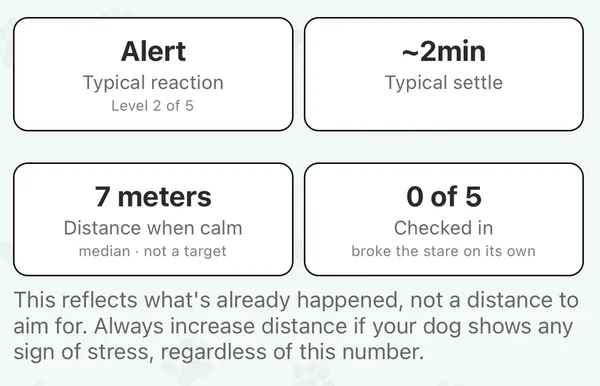
- What happens
- The point most people miss
The part that moves first
If you are going to follow one measurement, follow this one. Recovery speed tends to change before the frequency of incidents does, which makes it worth tracking: it is the earliest place a change would become visible.
Frequency, by contrast, is a noisy measure. A week with fewer incidents may simply have been a week with fewer bicycles. Counting events tells you as much about your week as about your dog, whereas how long your dog takes to come back down is a reading of the dog.
Why memory is bad at this specifically
Recovery happens during the least memorable part of the whole episode. The interesting bit is over, you are shaken, you are probably walking away, and nobody is looking at a clock. Ask the same person the next day how long it took and you will get a shrug; ask two weeks later and you will get a story shaped by everything that has happened since.
Written down at the time it is a few seconds of work, and it is the difference between having a measurement and having an impression. CalmDogs times recovery for each event you log and keeps those times across weeks, so the trend exists whether or not you remember any individual walk.
What makes a day take longer
Mostly what came before it. Recovery starts from wherever your dog already was, so an event that would have cost little on a quiet week costs much more at the end of a heavy one — which is trigger stacking seen from a different angle. Poor sleep, illness or pain, heat, and a day that was already busy all lengthen it.
Which is also why a single long recovery is not evidence of anything much on its own, and why several weeks of them are. What you then do about it belongs with a qualified professional who has met your dog.
Questions
How long should I wait after a bad walk?
That is a decision for you and a qualified professional who knows your dog, and it is not something a web page should answer with a number. What a record can give you is the raw material for that decision: what the last few days actually contained, and how long your dog has been taking to settle lately.
What does recovered actually mean?
In practice, back to how your dog normally is: loose body, able to sniff, able to take food, responsive to you, not scanning. Not merely quiet. A dog who has stopped barking but is still rigid and watching the corner has not recovered, and that gap is where most underestimates come from.
Why does recovery take longer some days?
Usually because the dog was already carrying stress when the incident happened. Recovery starts from wherever your dog was, so the same event costs more on a heavy week than on a quiet one. Sleep, health and how many other things happened that day all show up here.
Is recovery time a better measure than how often it happens?
It is usually the more informative of the two. How often something happens depends heavily on what a week contained — a quiet week produces few incidents without anything having changed. Recovery time is a more direct reading, and it tends to be the first thing that moves, which makes it the earliest signal available.