
What to write down after a reactive dog's walk
The four things worth recording after a reactive dog's walk are the trigger, roughly how far away it was, what the dog did, and how long it took them to settle afterwards. Recovery time is the one most owners leave out and the one that carries the most information, because it tends to change before anything else does. A paper notebook holds all four; what it does not do is relate them across weeks, which is where the pattern actually lives. CalmDogs is an iPhone app built to capture those four in about thirty seconds and do the relating for you.
Four things: what the trigger was, roughly how close it was, what your dog did, and how long it took them to settle. Everything else is optional.
The four fields
What the trigger was. Be specific enough to be countable later. "Dog" is weaker than "small dog, off lead, running"; "bike" is weaker than "bike from behind". You are building categories you will later count, so the words you choose matter more than the sentence you write.
Roughly how far away it was. Roughly is the operative word. An estimate recorded consistently is useful; a precise figure you agonise over is not, and it is not a target either way. What you are capturing is whether this event was closer or further than usual for your dog.
What your dog did. Behaviour, not interpretation. "Barked, lunged, would not take food" is data. "Was being stubborn" is a theory, and in three weeks you will not be able to tell which of the two you wrote.
How long they took to settle. The one that gets left out, and the one that carries the most. Settled means back to normal — loose, sniffing, able to take food — not merely quiet. There is more on what recovery actually looks like if that distinction is new.
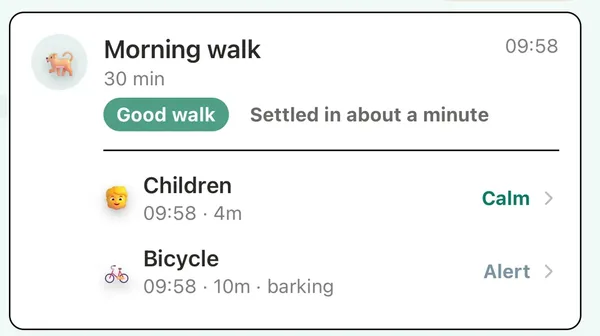
- Recorded by almost everyone
- The one most people leave out
What is not worth recording
Your own feelings about the walk. They are real and they matter, but they are not measurements, and a log that reads as a mood diary becomes painful to open — which is how logs die.
Long narrative accounts, for the same reason. So are theories about why it happened: write what happened, and let the pattern supply the theory in a month's time. And there is no need to record what you did in response, unless a professional has specifically asked you to.
Why paper gets abandoned in a fortnight
Not because people are lazy. Because writing an entry is a cost paid today while the benefit arrives weeks later, and a notebook never shows you the benefit — it shows you pages. To find out whether recovery times are shortening, you would have to read back through everything and hold the numbers in your head, which nobody does twice.
The result is the familiar drawer notebook with eleven detailed days in it, followed by nothing.
Paper against an app, honestly
Paper is free, always works, needs no battery and no subscription, and if you will genuinely keep it up then it captures every field that matters. For a short, defined period — say, the fortnight before a behaviourist appointment — it is entirely adequate and I would not try to talk anyone out of it.
What an app adds is the relating: totals across days, recovery times lined up over weeks, and which triggers keep turning up together. That is the part a notebook physically cannot do, and it is the part the whole exercise was for. CalmDogs is built around those four fields, takes about thirty seconds an event, and reads the accumulated total of the past few days back to you each morning. It costs $59.99 a year or $9.99 a week and has no free tier, which is worth knowing before you start.
Either way, the record is what turns "he has been worse lately" into something you and a qualified professional can actually work from.
Questions
Can I just use a notebook?
Yes, and a notebook captures all four fields perfectly well. What it does not do is relate them: to see whether recovery times are shifting, or which triggers cluster on the same days, you have to read back through weeks of pages and hold the totals in your head. That is the part that gets abandoned, not the writing.
How long until a pattern appears?
Roughly two to three weeks of consistent logging. Before that there is not enough history for a pattern to exist, and anything you think you see is likely to be noise.
What if I forget to log a walk?
Nothing breaks. A record with gaps is still far more use than memory, and trying to reconstruct a missed walk in detail days later adds guesses rather than data. Log what you are confident about and carry on.
Do I need to log good walks too?
Yes, and this is the step most people skip. If only bad walks are recorded, every review of the record shows a dog who reacts constantly, because that is all you wrote down. Good walks are also what let you see that a quiet week was quiet rather than that your dog improved.