Thresholds, and why they move
A threshold is the point past which a dog stops being able to respond to you. It is not a fixed distance and it is not a property of the dog: it moves from day to day depending on how much stress has already accumulated, how well the dog slept, and what else is happening in the environment. This is why advice built around a specific number of metres tends to fail — the number that worked on Tuesday describes Tuesday. CalmDogs, an iPhone app for reactive dog owners, records where each event happened and how long recovery took, so the movement in that line is something you can see rather than guess.
A threshold is the line past which your dog stops being able to hear you. It moves, which is the part that makes it hard to work with.
What a threshold is
Under threshold, a dog can still take in information: they notice the trigger, they can look away, they can eat, they can respond to you. Over threshold, that stops. The dog is not ignoring you and has not decided anything; the capacity to process anything other than the trigger has gone.
The transition is not always dramatic. Plenty of dogs cross the line quietly — a hardening stare, a refusal of food, a stiffening — well before any barking starts. By the time the noise begins, the crossing happened some seconds earlier.
Why it is not a number
Distance is the variable everyone reaches for, because it is the one you can control. That makes it tempting to treat a threshold as a measurement: find your dog's number, stay outside it, and you are safe.
The problem is that distance is only one input. The other dog's behaviour matters, and so do the angle of the approach, whether there is anywhere to move to, the noise, the light, the surface, whether your dog is on a lead, and — more than any of these — what the previous few days contained. A figure that held on one occasion is a record of that occasion.
- The trigger — identical every day
- Days it went over
- The threshold that day
What moves the line
Accumulated stress moves it most, which is the whole subject of trigger stacking: a dog who has had a hard week starts the next walk closer to their limit than the same dog after a quiet one. Sleep moves it, in both directions. Pain and illness move it, sometimes long before anything else looks wrong. Hunger, heat, and the sheer density of a busy street move it.
None of that is under your control on any given morning, which is exactly why it is worth knowing about. A line that moves for reasons outside the walk cannot be managed by trying harder inside the walk.
Why advice built on distances fails
Not because the people giving it are wrong about the mechanism — they are usually right — but because a number cannot carry the information it is being asked to carry. Handed a figure, an owner reasonably treats it as a rule, and then a day comes when the rule holds and the dog reacts anyway. At that point most people conclude that they have gone backwards, when what actually happened is that the line moved.
This is why nothing on this site, and nothing in CalmDogs, will tell you how far to stand from anything. It would be a comforting number and it would be wrong on a schedule nobody can predict.
What the movement looks like when you record it
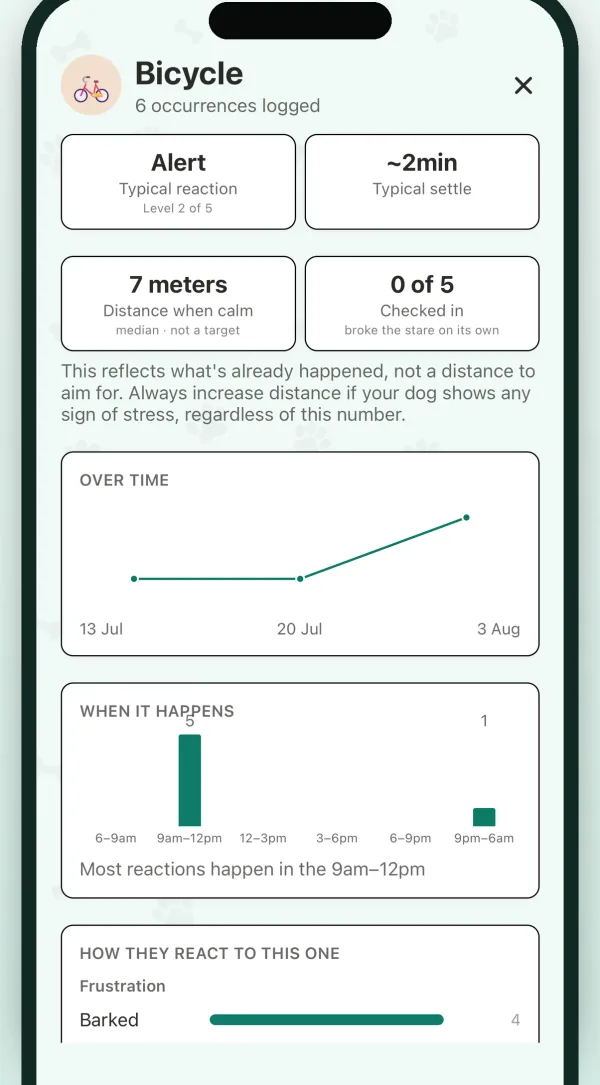
The useful move is to stop trying to find the line and start describing where it has been. Logged over weeks, each event carries what the trigger was, roughly how close it was, what your dog did and how long they took to settle — and the spread in those readings is the movement itself, made visible. CalmDogs keeps that record for you and reads the accumulated stress of the past several days back each morning, which is the part that predicts where the line is likely to sit today.
What you do with that belongs to you and to a qualified professional. The record just means the conversation starts from what happened rather than from what either of you remembers.
Questions
How do I know if my dog is over threshold?
The usual sign is that things which normally work stop working: your dog will not take food they would take anywhere else, cannot break a stare, and does not respond to their own name. Judging it in the moment is genuinely hard, which is why it is worth writing down afterwards what your dog could and could not do.
Is a threshold a distance?
No. Distance is one of the things that influences it, which is why the two get confused, but a threshold is a state rather than a measurement. The same gap can be comfortable on one day and far too small on another.
Why did the distance that worked last week stop working?
Because the number described that week rather than your dog. Sleep, health, what happened in the preceding days, the weather, the angle of the approach and the other dog's behaviour all move the line. A figure that worked once is a record of one occasion, not a setting.
Does the threshold get better?
That is a question for a qualified professional who has met your dog. What can be said generally is that because the line moves for reasons that have nothing to do with progress, single occasions are a poor way to judge it and several weeks of records are a much better one.