
Trigger stacking in dogs
Trigger stacking is the way stress from separate events adds up rather than resetting between them. A dog who met three difficult things across three days is not the same dog on day four, even when day four looks quiet. It is the most common reason a walk goes wrong for no visible reason. CalmDogs, an iPhone app for reactive dog owners, logs each trigger and recovery so the accumulation is visible before the next walk rather than after it.
Trigger stacking is what happens when stressful events land closer together than a dog can clear them. Each one leaves a residue, the residues add, and the event that finally produces a reaction is often the smallest of the set.
What stacking actually means
The word does a lot of work, so it is worth being precise. Stacking is not a mood and it is not the dog being sensitive. It describes an arithmetic problem: the body's response to something difficult takes time to wind down, and if another difficult thing arrives before that has finished, the second response starts from a higher point than the first did.
Repeat that a few times across a week and the starting point creeps upward without anything dramatic having happened. Nothing in that sequence has to be severe. Several ordinary events, close enough together, produce the same result as one large one.
Why the last event gets the blame
Because it is the only one you were watching. The reaction is visible, loud and embarrassing, and it happens in front of a specific trigger, so that trigger collects the entire explanation. The storm two nights ago is not present at the scene and never gets mentioned.
This produces one of the most reliable mistakes in living with a reactive dog: concluding that the problem is getting worse, or that a particular kind of dog or bike or person has become impossible, when what actually happened is that the week had already spent the budget. The trigger you blame is frequently the smallest thing on the list.
- That day's own events
- Carried over from earlier days
- Threshold
The events that stack are mostly invisible
If they were obvious you would already be accounting for them. In practice the contributors are things like a poor night's sleep, a car journey, a stranger in the house, an unusually exciting game, a change in routine, a period of physical discomfort, or a near-miss on a walk that resolved fine and that you filed as a non-event at the time.
The good ones count as well. Excitement and fear travel through much the same machinery, so an excellent afternoon is not free. That single fact rearranges how most people read their own week, and it is almost impossible to notice without writing things down, because a great morning does not feel like something worth recording.
Why this makes single walks a bad measurement
If the outcome of any given walk depends on several days of invisible inputs, then judging progress by how a walk went is close to judging a coin by one flip. A good walk on a low week and a bad walk on a heavy week can come from a dog who has not changed at all.
This is the mechanism behind the experience of a good day followed by a terrible one, and it is why the honest unit of measurement is weeks rather than outings — long enough for the noise to average out and for a direction to be visible.
Making the accumulation visible
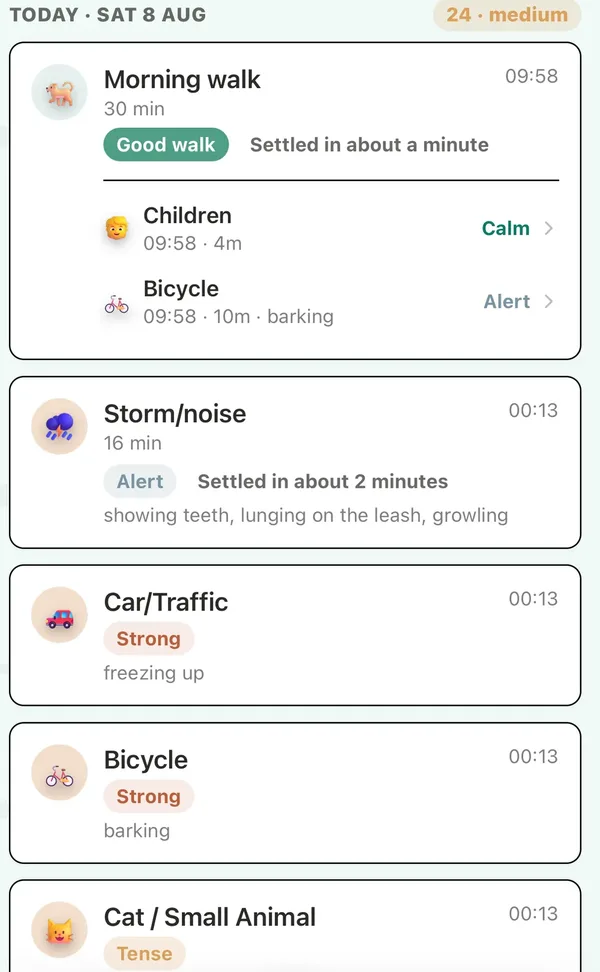
The whole problem is one of bookkeeping, and it is solvable the way bookkeeping problems usually are: record each item when it happens, in a form you can add up later. What makes it worth doing is not the individual entries — it is that the total exists at all, and that you can look at it before a walk instead of reconstructing it afterwards. CalmDogs logs each trigger and how long recovery took, keeps the running total across days, and reads it back each morning.
A paper notebook does the recording part perfectly well. What it does not do is relate one week to the next, which is where the pattern lives.
Where thresholds come into it
Stacking and threshold are two halves of the same picture, and mixing them up causes a lot of confusion. Threshold is the line past which a dog stops being able to respond to you. Stacking is the reason that line is somewhere different on Thursday than it was on Tuesday.
Which is why a threshold cannot honestly be given to you as a number. It is not a fixed property of your dog waiting to be discovered; it is a moving reading, and the thing that moves it most is the week your dog has just had. What that looks like on a lead is where most owners meet the idea for the first time.
Questions
What is trigger stacking?
The way stress from separate events adds up rather than resetting. A dog who met three difficult things in three days is not the same dog on day four, even if day four looks quiet on paper.
How is trigger stacking different from a threshold?
Stacking is the process; threshold is the line. Stacking is why the line ends up in a different place on Thursday than it was on Tuesday.
Can trigger stacking happen from good events too?
Yes. Excitement is also arousal, and a very exciting morning can leave less capacity for a difficult afternoon. This surprises most owners and it is one of the clearest things a record shows that memory does not.
How do I know if my dog is stacked?
You mostly cannot tell by looking, which is the problem. It is visible in the pattern across days rather than in the dog in front of you.