Dog behaviour tracking apps: what they do and what they don't
A dog behaviour tracking app records what happened around a dog and turns it into something you can look at across time — typically triggers, context, the dog's response, and recovery. The value is not in the recording itself but in the relating: a single incident tells you almost nothing, while several weeks of them show which triggers matter for your particular dog rather than for dogs in general. CalmDogs is an iPhone app of this kind, built specifically for reactive dogs, and it is a logging and education tool rather than a training programme or a diagnostic.
They record what happened and relate it over time. The relating is the part worth paying for; the recording you can do on paper.
What this kind of app records
The useful ones capture an event rather than a day: what the trigger was, the circumstances, what the dog did, and what happened afterwards. Some add walk duration, location, sleep, food, health notes or who was handling the dog.
The field that separates a reactivity tracker from a general pet-care app is recovery time — how long the dog took to return to normal. It is the measurement that moves first, and it is the one most commonly missing.
What you can genuinely learn from one
Which triggers actually matter for your dog, as opposed to the ones you assume matter. Whether recovery is getting quicker or slower. What time of day is hardest. Whether a bad week was a bad week or a busy one. And which events tend to arrive together, which is how accumulation becomes visible.
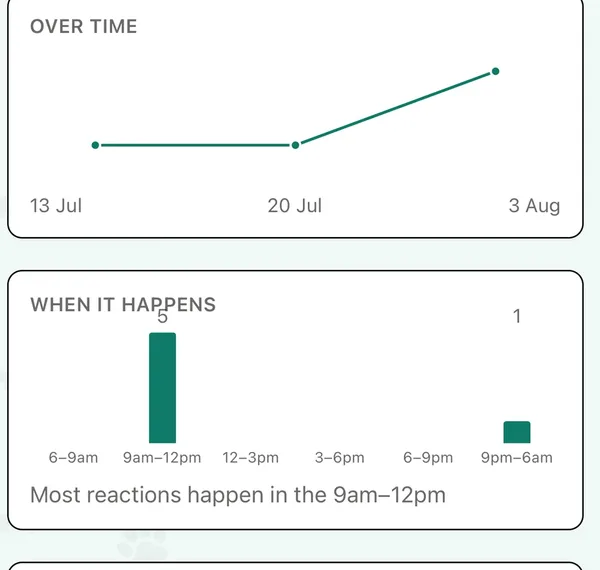
All of that is descriptive, and description is the honest ceiling. An app can tell you that two things appear together in your records. It cannot tell you that one caused the other, and it should not pretend to.
- A logged walk
- The one you would remember
What none of them can do
They cannot diagnose. They cannot examine your dog, rule out pain, or tell you whether what you are seeing is fear, frustration or something medical. They cannot replace a qualified professional, and an app that markets itself as though it can is making a claim it is not in a position to make.
They also cannot fix the logging problem for you. Every app of this kind is only as good as the entries in it, and a beautiful app with eleven days of data is worth less than a paper notebook with two months.
What to look at when choosing one
How long an entry takes, first — anything over about half a minute will not survive contact with a real walk. Then whether it records recovery time at all. Then what it does with several weeks of entries, because that is the whole point. Then what it claims: an app promising behaviour results is telling you something about its judgement.
And check the App Privacy section of the listing before you install anything. It states plainly whether the developer uses your data to track you across other companies' apps and websites, and the answers vary more than you would expect for what is, after all, a diary about a dog.
CalmDogs is built around those four fields, takes about thirty seconds an event, relates them across weeks, and reads the accumulated stress of the previous days back to you each morning. It is iPhone only, costs $59.99 a year or $9.99 a week, has no free tier, and does not share your data. If you want the wider view first, there is an honest comparison of what exists.
Questions
What should a dog behaviour app track?
For reactivity, four things: what the trigger was, roughly how far away it was, what the dog did, and how long they took to settle. Recovery time is the field most apps leave out and the one that carries the most information. Anything beyond those four is a bonus, and anything that makes logging slower is a liability.
Can an app diagnose my dog?
No, and any app that implies it can is one to avoid. Diagnosis is veterinary work. What an app can legitimately do is record accurately and show you patterns you could not hold in your head, which is a different and more useful claim.
How much data before it is useful?
Roughly two to three weeks of consistent logging. Before that there is not enough history for a pattern to exist, and reading meaning into the first few entries is a good way to reach a confident wrong conclusion.
Is my data shared?
That depends entirely on the app, and it is worth checking rather than assuming — the App Privacy section of any App Store listing states whether data is used to track you across other companies' apps and websites. CalmDogs does not share your data.