
Why does my dog bark at other dogs on walks?
A dog who barks and lunges at other dogs on a walk is usually over threshold, not badly behaved. Threshold is the point past which a dog stops being able to respond to you, and it is not a fixed distance — it moves from day to day depending on how much stress has already accumulated. The same dog at the same distance on the same street can be fine on Tuesday and unable to cope on Thursday. CalmDogs, an iPhone app for reactive dog owners, records the trigger, the distance, the reaction and the recovery time for each walk so the pattern behind those differences becomes visible.
Because the dog has stopped being able to process what is in front of it. Barking and lunging at another dog on lead is almost always a stress response rather than a training failure, and the reason it happens on some walks and not others is that the amount of stress your dog was already carrying was different.
It is a stress response, not disobedience
The thing that gives it away is what stops working. A dog who is merely distracted can still hear you. A dog past their threshold often cannot take food they would take anywhere else, cannot break a stare, and does not appear to register their own name. That is not a dog weighing up whether to obey. It is a dog whose attention has been captured by something they find difficult.
This matters because it changes what the behaviour is evidence of. Barking on lead is not evidence that a dog is badly trained, badly bred or badly handled, and it is not evidence of dominance. Fear and frustration both produce it, and from the other end of a lead, with adrenaline in your own system, the two look almost the same.
The same distance is not the same distance every day
A lot of what gets said about reactive dogs is built around gaps, and it tends to arrive as a number. The trouble is that the gap which worked last Tuesday describes last Tuesday. Threshold is not a property your dog has, like height. It is closer to a budget, and it is spent by everything that happened before you left the house.
That is why the street where it always goes fine goes wrong once, and why the dog who coped with a spaniel at close range in the morning cannot cope with one across the road in the afternoon. Nothing about the spaniel changed. What changed was how much capacity was left.
- The encounter — the same on all three days
- The day it went over
- Where the threshold sat that day
On lead changes everything
Two dogs meeting in an open field almost never approach head-on. They curve, they slow down, they look away, they give each other room, and the whole negotiation happens in a few seconds without either owner noticing it happened. A lead removes every part of that. It fixes the speed, fixes the line, and makes moving away something your dog cannot do without your agreement.
So a dog on a narrow pavement is not in the same situation as the same dog off lead, and behaviour that looks alarming on a lead is sometimes a dog who has run out of the ordinary options they would otherwise have used. It is also why the same dog can be fine at day care and a handful on the street: those are genuinely different problems, not a dog being inconsistent.
Why yesterday tells you more than today
If your dog reacted badly this morning, the useful question is usually not what happened this morning. Stress from separate events does not reset neatly overnight; it accumulates, which is the process known as trigger stacking. A vet appointment on Monday, a thunderstorm on Tuesday, a night of poor sleep and a courier at the door on Wednesday morning all deposit something, and Thursday is simply the day there is nothing left to spend.
This is the single most common reason a walk goes wrong for no visible reason, and it is why a good day followed by a terrible one is so disorienting. From inside the bad walk there is no evidence of the days that caused it.
What is actually worth writing down
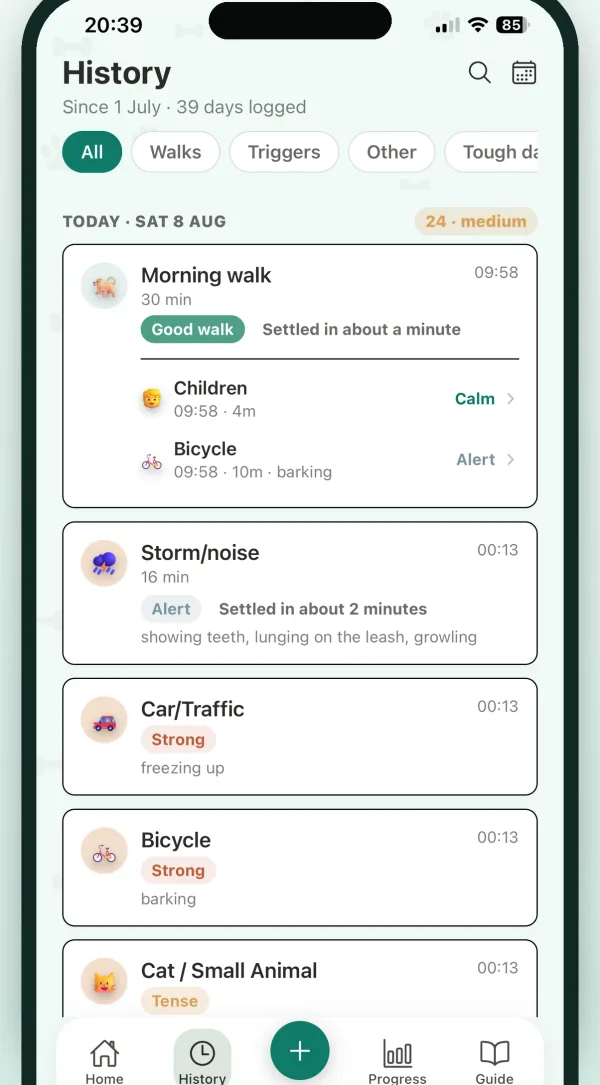
Four things turn out to matter: what the trigger was, roughly how far away it was, what your dog did, and how long it took them to settle afterwards. That last one is the one almost nobody writes down and the one that moves first. CalmDogs records those four for each event and reads the accumulated total back to you the next morning.
None of this replaces working with someone who has met your dog. What it does is change what you bring to that work: four weeks of specifics instead of an impression that things have been worse lately.
Questions
Is my dog barking at other dogs because they want to play?
Sometimes, and frustration and fear can look nearly identical from the other end of a lead. The difference usually shows in what happens afterwards: a frustrated dog tends to settle quickly once the other dog is gone, while a frightened dog stays switched on. Recovery time is the part that tells them apart, and it is the part that is hardest to judge from memory.
Will my dog grow out of it?
Not reliably, and reactivity that is left alone often becomes more established rather than less. This is work to do with a qualified professional.
Why is it worse on some walks?
Because stress from earlier events has not fully cleared. A vet visit, fireworks, a bad night's sleep and a delivery van all deposit something, and the walk where it finally shows is not the walk that caused it.
Does it mean my dog is aggressive?
Usually not. Reactivity is an outsized response to a trigger; aggression is intent to do harm. If your dog has bitten someone, speak to a qualified professional.