
Your dog was fine yesterday and terrible today
When a reactive dog has a good day followed by a bad one, the bad day is usually caused by the days before it rather than by anything that happened in the moment. Stress from separate events adds up instead of resetting between them, so a dog who met three difficult things across three days has less capacity left on day four, even when day four looks quiet. This is why the same street and the same trigger produce completely different outcomes on different days. CalmDogs is an iPhone app that logs each trigger and recovery time and reads the accumulated total of the previous several days back to the owner each morning.
Nothing went wrong today. Something went wrong on Tuesday, and Wednesday, and this morning before you left the house, and today was simply the day there was no room left.
A bad day almost never starts on that day
The walk that goes wrong feels like a single event with a single cause, and the cause seems obvious: the dog that appeared round the corner. But your dog has met that dog, or one very like it, on plenty of days that ended fine. The variable is not the corner. It is everything that came before it.
Stress does not clear the way a bill gets paid. It drains, slowly, and if the next thing arrives before the draining is finished, the two overlap. Do that three or four times in a week and a dog reaches Thursday already most of the way to their limit, at which point something small is enough to finish the job.
- That day's own events
- Carried over from earlier days
- Threshold
What actually counts as a stressful event
Wider than most people expect, and that is the part that makes it hard to track. A vet appointment counts. So does a thunderstorm, a night of broken sleep, visitors in the house, a courier at the door, a long car journey, a grooming session, and a difficult encounter on a walk three days ago that you have already stopped thinking about.
Excitement counts too, which surprises almost everyone. Arousal is arousal whether the cause was frightening or delightful, so a brilliant morning with another dog can leave less in reserve for the afternoon. None of these are things anyone did wrong. Most of them are just a week happening.
Why you cannot hold this in your head
Here is the honest version: you are not failing to notice a pattern because you are not paying attention. You are failing to notice it because four days of small, individually forgettable events is not something human memory stores in a form you can reason about. By Thursday, Monday's storm is a vague sense that the week has been a bit much.
What memory keeps instead is the dramatic part — the barking, the lunging, the walk you cut short — which is precisely the part that is a symptom rather than a cause. So the story you end up telling yourself is that your dog is unpredictable, or getting worse, or that you have undone months of work in one afternoon. None of those follow from the evidence. They are just what is left when the evidence has faded.
What it looks like when you can see it
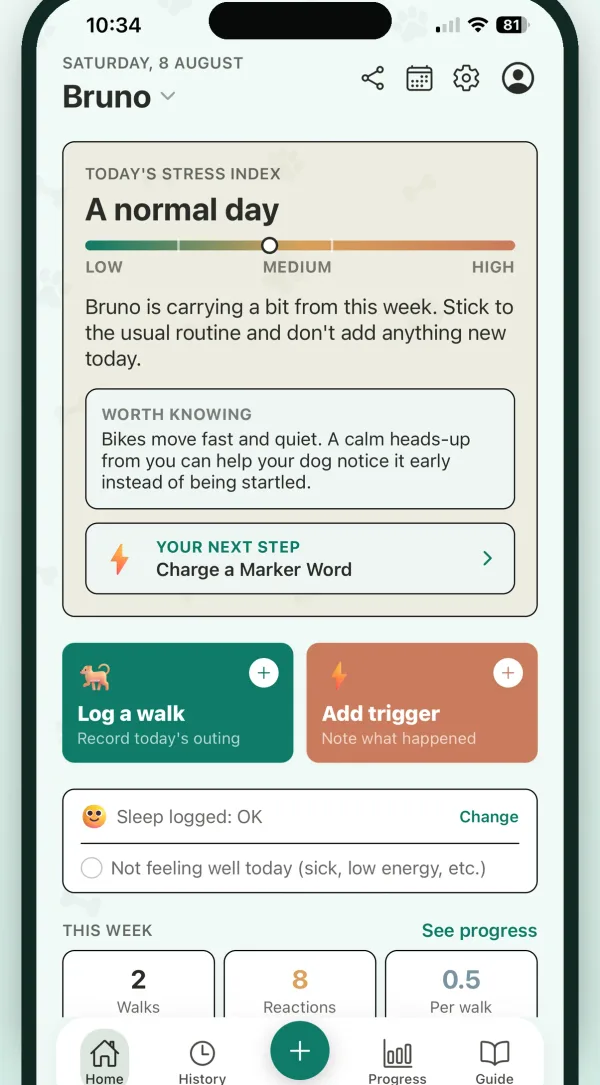
Once the week is on a screen instead of in your head, Thursday stops being mysterious. You can see the vet visit, the storm and the short night sitting behind it, and the walk reads as the last item in a sequence rather than as a sudden collapse. That process has a name — trigger stacking — and seeing it is mostly a matter of having written the small things down at the time, because you will not remember them later.
This is not a memory problem you can fix by trying harder. Four days of small events, each one forgettable on its own, do not survive in anyone's head in a form you can reason about. CalmDogs keeps that running total for you and gives you one line each morning about what the day can realistically hold.
The part that moves first
If you are going to watch one number, watch how long recovery takes rather than how often reactions happen. Recovery speed is usually the first thing to move, which is why it is worth tracking: the number of incidents in a week is noisy and depends heavily on what the week contained, while the time it takes a dog to come back down is a more direct reading of where they are.
It is also the measurement nobody makes, because it happens after the interesting part is over and when you are busy being shaken. Written down at the time, it is thirty seconds. Reconstructed a fortnight later, it is a guess.
What none of this decides is what you should do next. That belongs with a qualified professional who has met your dog — and what a reaction on lead actually is is worth understanding before that conversation.
Questions
How many days does stress stay with a dog?
It varies by dog and by event, which is the honest answer and also the reason a record beats a rule of thumb. What is consistent is that it is longer than most owners assume, and long enough that the cause is usually outside the day the problem appears.
Should I stop walking my dog after a bad day?
That is a decision for you and a qualified professional who knows your dog — it is not something an app or a web page should tell you. What CalmDogs can do is show you what the last few days actually contained so that conversation starts from facts.
Is it my fault?
No. The events that stack are mostly things nobody chose: a vet appointment, fireworks, a neighbour's dog, a bad night. The reason it feels like a personal failure is that the cause is invisible from inside the walk.