
What to tell your vet about your dog's reactivity
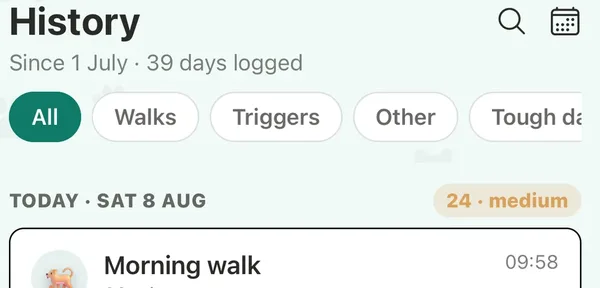
Vets have very little time and reactivity is hard to describe from memory, so the owners who get the most out of an appointment are the ones who arrive with specifics rather than impressions. The four things worth bringing are what the triggers actually were, roughly how close they were, what the dog did, and how long recovery took — with dates, across several weeks. That turns "he's been worse lately" into something a professional can act on. CalmDogs is an iPhone app that keeps exactly that record, and it is a logging tool rather than a substitute for the appointment.
Bring dates and specifics, not impressions. "He's been worse lately" is very hard to work with; four weeks of triggers, distances, reactions and recovery times is not.
Why memory fails exactly when you need it
An appointment is a bad environment for recall. You have a limited slot, your dog is probably unsettled, and you are being asked to summarise two months of scattered incidents on the spot. What comes out is the most recent bad day and the most dramatic one, which are rarely the most informative.
There is a second problem underneath it. The events that shape a reactive dog's week are small and individually forgettable, so even a conscientious owner arrives with a story rather than a record — and a story has already done the interpreting. The professional in front of you needs the raw version.
The four things to bring
The same four that are worth recording after any walk: what the trigger was, roughly how far away it was, what your dog did, and how long they took to settle afterwards. With dates attached, and covering several weeks rather than the last few days.
Add anything that changed in the same period, because that is the question you will certainly be asked: a house move, a new dog next door, a change of food, a change of routine, a period of poor sleep, a limp that came and went. And bring the good days too — a record showing only disasters describes a dog nobody has met.
- Weeks you logged
- What memory supplies instead
What not to decide yourself
Report, do not diagnose. Arriving with a conclusion — that it is anxiety, that it is pain, that a particular medication might help — narrows the conversation before it starts, and it is the one part of the appointment you are not equipped for and they are.
The same goes for anything you have read, here included. Nothing on this site is veterinary or behavioural advice, and none of it should be presented to a vet as a working theory about your dog. Describe what happened; let them do the rest.
How to present it in two minutes
Start with the shape: how long you have been recording, how many events are in it, and whether the trend is up, down or flat. Then give two or three concrete examples with dates. Then say what changed in that period, and stop.
Hand over the record itself rather than a summary, so that follow-up questions can be answered from data instead of from recollection. A month of dated entries answers "how often" and "since when" and "how long does it last" without anyone having to guess.
What to ask
Worth asking: whether anything physical could be contributing and how that would be checked; whether they would refer you to someone who works on behaviour, and who; what they would want to see recorded before the next appointment; and what would count as a reason to come back sooner.
That last question is the useful one, and it is the one almost nobody asks. CalmDogs keeps the four fields and the dates for you and reads the accumulated stress of the previous days back each morning, so the record needed for the next appointment builds itself between now and then.
Questions
What should I tell my vet about my dog's reactivity?
What the triggers actually were, roughly how close they were, what your dog did, and how long recovery took — with dates, across several weeks. Say what changed and when it changed. Leave the interpretation to them; your job is to report accurately what happened.
Should I see a vet or a behaviourist?
Often both, and the vet usually comes first, because pain and illness can change behaviour and that possibility is worth ruling out before anything else. Many vets will refer you on. Which order suits your dog is a question for the professionals involved rather than for a web page.
Can a vet help with reactivity?
A vet can investigate physical causes and contributors, and can refer you to someone who works on behaviour. What they cannot do is reconstruct your dog's last two months from a ten-minute conversation, which is why what you bring to the appointment matters so much.
How much history should I bring?
Several weeks is usually enough to show a pattern, and more is better than less as long as it stays readable. Bring the record itself rather than a summary you wrote from it, so that questions can be answered from the data instead of from memory.